
Beyond job descriptions: Why skills, not roles, will define the future of work
SHARE THIS ARTICLE

The future will still contain jobs. Organisations will still need accountability, reporting structures, and clear responsibilities. But the job will no longer be the most useful lens through which to understand human potential, writes Dr Mahmood Ahmed Khan.
When the document defining work becomes the constraint
At 9:03am on Monday morning, a hiring manager opens a familiar document: Job Description – Senior Marketing Manager.
It lists responsibilities. Years of experience. Required qualifications. Reporting lines. A neat collection of expectations designed to describe one person doing one job.
But there is a problem.
The business has changed since the document was written.
The marketing team now needs someone who can interpret customer data, orchestrate AI tools, understand automation, create compelling narratives and collaborate with product and sales. The title has survived. The work has not.
This is the paradox confronting modern HR: we are still hiring for jobs in a world increasingly organised around skills.
Deloitte research found that 63 per cent of work is already performed outside people’s core job descriptions, while 81 per cent of executives say work increasingly crosses functional boundaries. Only 19 per cent believe traditional jobs are the best way to organise work for business goals.
The job description is not disappearing overnight.
It is simply losing its monopoly.
The future of work will not ask, “What is your job?”. It will increasingly ask, “What can you do and what can you learn to do next?”.
From job titles to portfolios of capability
For decades, HR built its architecture around the job.
Recruitment began with a requisition. Compensation was attached to a position. Training was assigned according to role. Performance was evaluated against responsibilities. Career progression meant moving from one job title to another.
It worked when work was relatively stable.
Today, technology, AI, shifting customer expectations and fluid organisational structures are continuously changing what needs to be done. A static job description cannot keep pace with dynamic work.
The alternative is a skills-based organisation – one where skills, capabilities and potential become the fundamental currency of workforce decisions.
Deloitte describes the shift as moving from a one-to-one relationship between workers and jobs toward a many-to-many relationship between people, skills and work.
That sounds theoretical until it changes how a company hires.
Imagine a company searching for a data scientist but finding very few candidates with the exact title. A skills-based approach asks a different question: Who possesses the underlying capabilities?
Perhaps the strongest candidates are statisticians, software engineers, analysts or researchers with adjacent skills and the capacity to learn quickly.
The talent pool suddenly becomes larger.
And more importantly, the organisation begins hiring for potential rather than pedigree.
The death of the perfect candidate
The traditional job description often creates an imaginary person: five years of experience, three certifications, a specific degree, expertise in six technologies and the mysterious ability to be “a self-starter.”
The result can be predictable. Candidates who do not match the checklist are filtered out – even when they could perform the work exceptionally well.
Skills-based hiring turns the process around.
Instead of asking whether someone has occupied the same role before, HR asks whether the individual possesses the capabilities required to deliver the desired outcome.
This distinction is increasingly important as technology changes skill requirements faster than conventional career structures can respond. The World Economic Forum’s Future of Jobs Report 2025 identifies resilience, flexibility and agility among the capabilities distinguishing growing from declining roles, alongside the rising importance of technological literacy.
“The strongest candidate may not have the right job title on their resume. They may have the right skills hiding behind the wrong one.”
Skills become the new organisational currency
Consider an employee in finance who has quietly developed advanced data visualisation skills.
Under a traditional model, she remains a finance specialist.
Under a skills-based model, those capabilities become visible.
The marketing team needs dashboard expertise. A strategy project needs analytical thinking. A transformation initiative needs someone who understands both numbers and storytelling.
Suddenly, one employee can contribute across several areas without changing employers – or necessarily changing her formal title.
That is the real power of skills architecture.
It transforms talent from a collection of positions into a dynamic capability network.
Deloitte’s research suggests that skills-based organisations can unlock greater workforce agility by allowing skills to move more fluidly toward changing business needs. Its 2025 analysis emphasises dynamic skills frameworks, skills data and technology as infrastructure for this model.
The solution: Build a skills operating system
The challenge is that declaring “skills matter” is easy.
Building the infrastructure to make them matter is considerably harder.
Organisations need a living skills architecture that connects workforce data with business strategy. It should identify the capabilities the organisation has today, the capabilities it will need tomorrow and the gaps between them.
That means moving beyond a static competency catalogue toward a skills intelligence system: continuously updated, evidence-based and connected to hiring, learning, internal mobility and workforce planning.
AI can accelerate this process by mapping skills from resumes, projects, learning records and work outcomes. But humans must remain accountable for interpreting context, validating capability and making consequential talent decisions.
The graph below illustrates why this transition is becoming difficult to ignore.
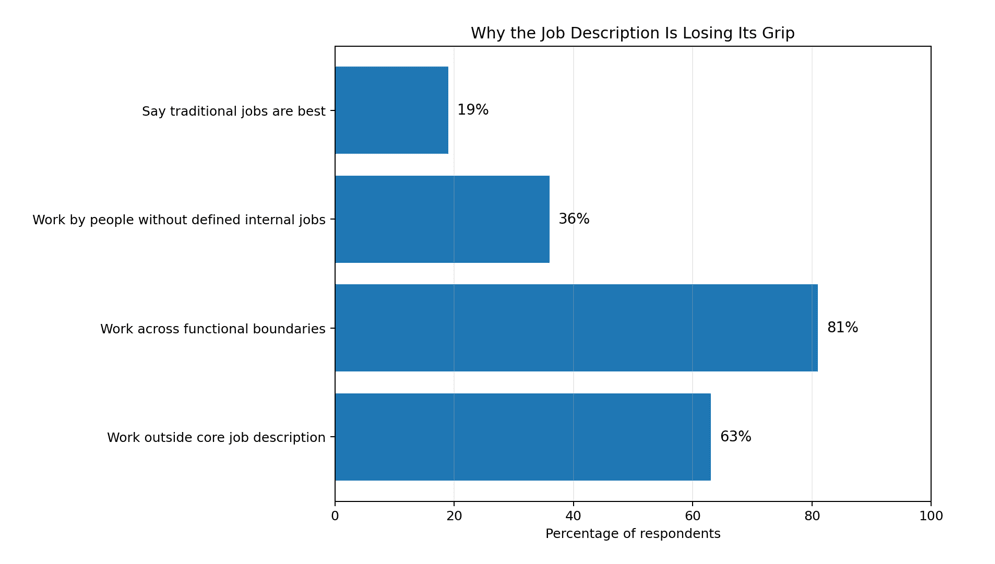
Source: Deloitte global research. The figures represent reported organisational conditions and preferences; they are not a forecast.
The practical transformation is therefore not to abolish every job description.
It is to demote it.
Keep the role where it provides legal, organisational or operational clarity. But place a dynamic skills profile underneath it. Let that profile inform hiring, development, deployment, succession and career mobility.
The job description should become the map of where someone starts – not the boundary of where their contribution can go.
The career ladder becomes a career lattice
The old career model was vertical: employee, manager, director, executive.
The emerging model is more fluid.
A person might move sideways into a project, acquire new capabilities, contribute to another function, return to their core discipline and later move into leadership. Careers become portfolios of experiences rather than a sequence of titles.
That is not merely better for employees.
It gives organisations something they desperately need: optionality.
When markets shift, companies with visible skills can redeploy talent instead of immediately buying it from outside. When technology changes, they can identify adjacent capabilities and reskill people before declaring their roles obsolete.
Skills-based organisations are therefore not simply an HR innovation.
They are an organisational resilience strategy.
HR’s next mandate
The future will still contain jobs. Organisations will still need accountability, reporting structures and clear responsibilities.
But the job will no longer be the most useful lens through which to understand human potential.
The real competitive advantage will belong to organisations capable of seeing beyond titles – to the capabilities underneath them.
Tomorrow’s CHRO may spend less time asking, “How many people do we need for this role?”
And far more time asking:
“What work needs to be done, what skills will deliver it, and where is that capability already hiding?”
That is the moment HR stops managing positions and starts orchestrating potential.
The job description may be dying.
The skills economy is only beginning.
Dr Mahmood Ahmed Khan is the founder of Global HR Management Services and author of Human Advantage in the Age of AI.
 Want to see more stories from trusted news sources?
Make HR Leader a preferred news source on Google.
